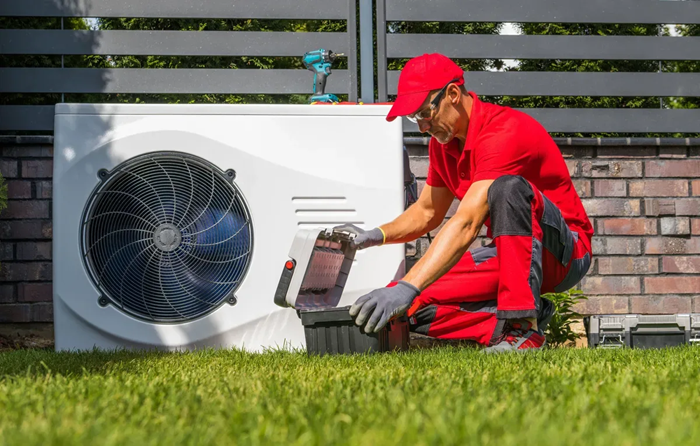
A heat pump is an engineering system that provides heating, cooling, and hot water using ambient heat.
To ensure stable, economical operation and avoid unscheduled downtime, it is important to perform regular maintenance, adhering to the manufacturer’s requirements and the specific connection diagram.
Proper maintenance includes checking the circuits for leaks and pressure, checking the automation, cleaning the heat exchangers, diagnosing the sensors, and assessing actual efficiency. Regular maintenance helps preserve the compressor’s lifespan, reduce energy consumption, and avoid costly repairs during peak season.
Timing and Frequency: What and When to Check
Frequency depends on the pump type (air-to-water, air-to-air, ground-to-water, water-to-water), the intensity of use, and the quality of the coolant. On average, scheduled maintenance is performed 1-2 times a year: before the heating season and/or before the active cooling period.
Monthly (or every 1-2 months) – basic inspection
- Inspect the outdoor unit: no mechanical damage, clean grilles and heat exchanger, free air flow.
- Check drainage and condensate drainage: prevent flooding and freezing in unwanted areas.
- Monitor noise and vibration: new sounds often indicate problems with the fan, mounts, or bearings.
- Monitor errors on the controller: even one-time codes should be recorded and analyzed.
Seasonal maintenance every six months
Before the season, it is important to adjust the modes and inspect critical components. In systems with a water circuit, the circulation condition and coolant quality are additionally assessed.
- Cleaning heat exchangers (outer and inner circuits) without damaging the fins and coatings.
- Checking fans: impeller, balancing, fastenings, absence of interference.
- Automation diagnostics: accuracy of sensor readings, operating logic of three-way valves, pumps, and heating elements (if applicable).
- Checking filters in the hydraulic module and mesh filters on the return line (for heating/DHW circuits).
Annually – extended diagnostics
It is recommended to entrust annual maintenance to certified specialists: a measuring base and permission to work with refrigerant are required. This is especially important for inverter systems, where the accuracy of the parameters affects the service life of the compressor and electronics.
- Refrigerant circuit inspection: pressure and temperature checks by mode, assesses superheating/subcooling, and searches for signs of leaks.
- Electrical inspection: terminals, contactors/relays, connection quality, cable and grounding condition.
- Mode testing: heating, cooling, defrost (for air-to-water/air-to-air), DHW priority.
- Hydraulic assessment: system pressure, expansion tank operation, safety valve status, flow rate/temperature drop.
Every 2-3 years – in-depth condition-based maintenance.
The interval depends on water quality, the presence of antifreeze, operating mode, and environmental pollution. In some cases, such maintenance may need to be performed more frequently if the system operates at extreme temperatures or is operated continuously.
- Flush the heat exchanger (hydraulic section) if there are signs of silting or a drop in flow rate.
- Replace/replenish the coolant (antifreeze) with concentration and pH monitoring.
- Check and maintain valves: valves, actuators, mixing units, check valves.
Important: tampering with the refrigerant circuit without qualifications and permits is dangerous and often voids the warranty. If you need to upgrade the air conditioning system or integrate it with the cooling system, you can order air conditioner installation at https://friros.fi and coordinate the compatibility of the solutions with the heat pump.
Compliance with maintenance schedules is not a formality, but a practical way to maintain system efficiency at the design level and extend the service life of key components.
Seasonal and Hours-Based Maintenance Calendar
It’s more convenient to manage maintenance schedules simultaneously in two «coordinates»: by season (what to do before and after peak loads) and by hours-based (what to do at specific intervals during actual operation). This approach reduces the risk of missing important procedures, especially if the heat pump operates in heating mode almost constantly or, conversely, primarily in hot water/cooling mode.
Experience shows that most emergency shutdowns are not due to a «compressor failure,» but to accumulated issues: clogged filters and heat exchangers, deteriorating heat transfer from the outdoor unit, decreased circuit flow, pressure/flow errors, and gradual degradation of settings. A maintenance calendar transforms maintenance from reactive to planned.
Seasonal Schedules
- Before the heating season (late summer – early fall):
- Clean the outdoor unit: heat exchanger fins, drip tray, drains, check for obstructions to airflow.
- Check the condition of pipe insulation, fasteners, vibration dampers, and ensure there are no chafing or condensation in unwanted areas.
- Check filters/mud traps in the hydraulic circuit, flush if necessary, and monitor the pressure drop across the filter.
- Check the circuit flow/pressure, ensure the circulation pump(s) are working properly, and check the valves and actuators for proper operation.
- Check the automation settings: heating curve, temperature limits, anti-freeze modes, and schedules.
- Check the temperature/pressure sensors for adequate readings (comparison) (with a reference thermometer/pressure gauge, if possible).
- During the peak heating season (winter):
- Monitor the defrost frequency, ensure there are no long «hangs» in defrost, assess the cleanliness of the heat exchanger and tray.
- Monitor noise/vibration, record errors/warnings in the log, check the stability of the supply/return line temperatures.
- Visual inspection for water/glycol leaks, tighten connections as needed (do not overtighten).
- Before the cooling season (spring):
- Clean the outdoor unit of lint/dust after winter and the off-season, restore free airflow.
- Check the condensate drain and drains (relevant for indoor units/fan coils/hydromodules), Elimination of overflows and blockages.
- Checking the minimum supply temperature limit settings in cooling (condensation protection, compatibility with the distribution system).
- After the peak load season (late spring or early summer):
- Analysis of the error log and statistics: number of starts, average/maximum temperature, defrost frequency, cyclicity.
- Scheduling «deep maintenance» work for the low-load period (when system shutdown is less critical).
Running hours regulations (guidelines)
- Inspection of the outdoor unit, cleaning from contaminants.
- Check the filter/mudguard, flush if there are signs of blockage.
- Checking the parameters in the menu (temperatures, flow/pressure, errors).
- Checking and tightening terminals/contacts in the control panel (with the power off).
- Checking the operation of pumps, valves, servomotors, and correct mode switching.
- Checking the tightness of the hydraulic circuit, the condition of the insulation, fasteners, and vibration elements.
- «Deep» cleaning of heat exchangers (according to the manufacturer’s instructions and with suitable products).
- Checking the composition and condition of the coolant (for systems with glycol — concentration, pH/inhibitors according to regulations).
- Checking the heating curve settings and DHW logic for compliance with actual operating conditions.
- Complete preventive inspection by the service, checking sensors and protections, assessing error trends.
- Checking the refrigeration circuit according to Manufacturer’s requirements (if warranted and within tolerances): signs of leaks, correct operation.
- Maintenance of associated heating/cooling system components: expansion tank, safety valves, air vents.
Bottom line: the best maintenance schedule is one that’s tailored to your operating conditions: seasonal inspections cover «peak risks,» while intervals based on operating hours cover «cumulative problems.» Record the date, hours, and results of each procedure in a logbook—this simplifies diagnostics, helps plan service, and maintains consistent heat pump efficiency.